What Do You Already Have?
When we are overwhelmed by a crisis, our natural instinct is to look at what we are missing. We look at our bank accounts, our exhausted energy, or our lack of connections and assume that the solution must come entirely from the outside—a sudden rescue or a spectacular wonder out of nothing. While it is true that we serve a God who can speak entire universes into existence from a literal void, biblical history reveals another deeply intimate pattern of divine intervention.
Frequently, God chooses not to bypass us, but to involve us. He begins our breakthrough with a simple, arresting question: What do you already have?
The miracle is often not found in waiting passively for a spectacular sign to drop from heaven. Instead, it is activated when we surrender the small, seemingly insufficient resources already in our hands and allow God to use and multiply them.
From Lack to Abundance
In 2 Kings 4:1-2 (NLT), “One day the widow of a member of the group of prophets came to Elisha and cried out, ‘My husband who served you is dead, and you know how he feared the Lord. But now a creditor has come, threatening to take my two sons as slaves.’ ‘What can I do to help you?’ Elisha asked. ‘Tell me, what do you have in the house?’”
In these verses, we find a desperate widow facing a catastrophic reality. She runs to the prophet Elisha, crying out in her distress, but notice that he does not immediately hand her silver or gold. Instead, he invites her to pivot from her devastation by asking a highly intentional question about what she already possesses.
Her initial response is completely dismissive: "Nothing at all..." But then, she remembers one seemingly insignificant detail: "...except a flask of olive oil."
The Hebrew word used here for the jar describes a tiny, shallow cosmetic vial—barely enough for a single anointing. To the widow, this flask was a symbol of her absolute lack. But to Elisha, it was the seed for her deliverance.

Oil multiplying from a tiny flask
By instructing her to borrow empty vessels from her neighbors and pour from that single vial (in verse 3), Elisha invited her to actively partner with God. The miracle did not happen in a vacuum; it happened as she poured out what she already possessed. The oil flowed continuously, filling every single container.
Now, when the oil stopped flowing, the woman found herself in a new dilemma. She was surrounded by a house full of oil, but she still didn’t have a single coin to pay her debt. Her response was going back to Elisha before touching the oil. This could mean 2 things:
a) She recognized that divine provision requires divine direction
Having the resource is not the same as knowing how to steward it. She had the physical proof of God's power in her room, but the threat to her sons was still active outside her door. She refused to act on human impulse with a sacred miracle.
b)The Paralysis of a Crisis Mindset
It seems obvious to us today: if you have a product in high demand (olive oil was a valuable commodity used for cooking, lighting, and religious rituals), you sell it.
But she was a traumatized widow facing the immediate enslavement of her children. People in extreme survival modes often lose the ability to think strategically or long-term. She could see the oil, but her mind was still trapped in the reality of bankruptcy.
The Conversion of Miracle to Market
Elisha’s response is sharp, practical, and business-minded: "Go, sell the oil and pay your debts. You and your sons can live on what is left." (verse 7)
Notice the order of operations Elisha lays out:
"Go, sell the oil": God provided the supernatural supply, but she and her sons still had to do the natural work of marketing and selling it.
"Pay your debts": Integrity came first. From what she earned, she was to settle her debts.
"Live on what is left": The surplus was her future security.
A Consistent Pattern
This story is not an isolated event in the Bible. God routinely uses the ordinary and insufficient things we hold to meet our needs and accomplish the extraordinary.
(i) Moses and the Shepherd’s Staff (Exodus 4)
When God called Moses to confront Pharaoh and liberate millions of Israelites from slavery, Moses was terrified and felt entirely inadequate. God asked him, "What is that in your hand?" Moses replied, "A staff." It was just a common piece of wood used for herding sheep. Yet, when Moses surrendered it to God, that ordinary stick became "the staff of God." It was used to bring plagues upon Egypt, split the Red Sea, and draw water from a desert rock.
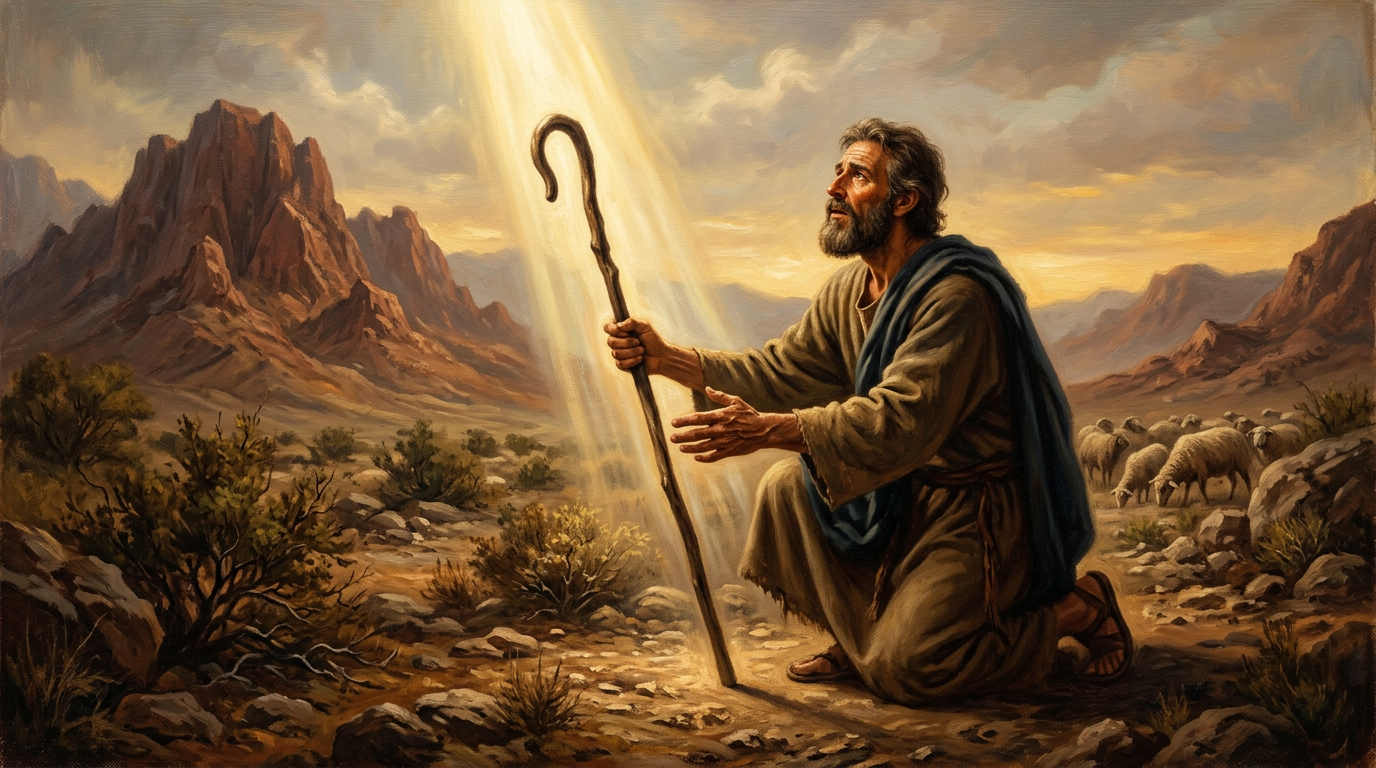
Moses holding wooden shepherd staff
(ii) The Boy’s Five Loaves and Two Fish (John 6)
Faced with a starving crowd of over 5,000 people in a remote place, Jesus' disciples calculated the cost of buying food, concluding it was impossible. But Jesus asked what food was already available. Andrew found a young boy with five small barley loaves and two small fish. To the disciples, it was a joke compared to the massive need. But Jesus took the boy’s lunch, gave thanks, and broke it. It multiplied until the entire crowd was stuffed, leaving twelve baskets of leftovers.
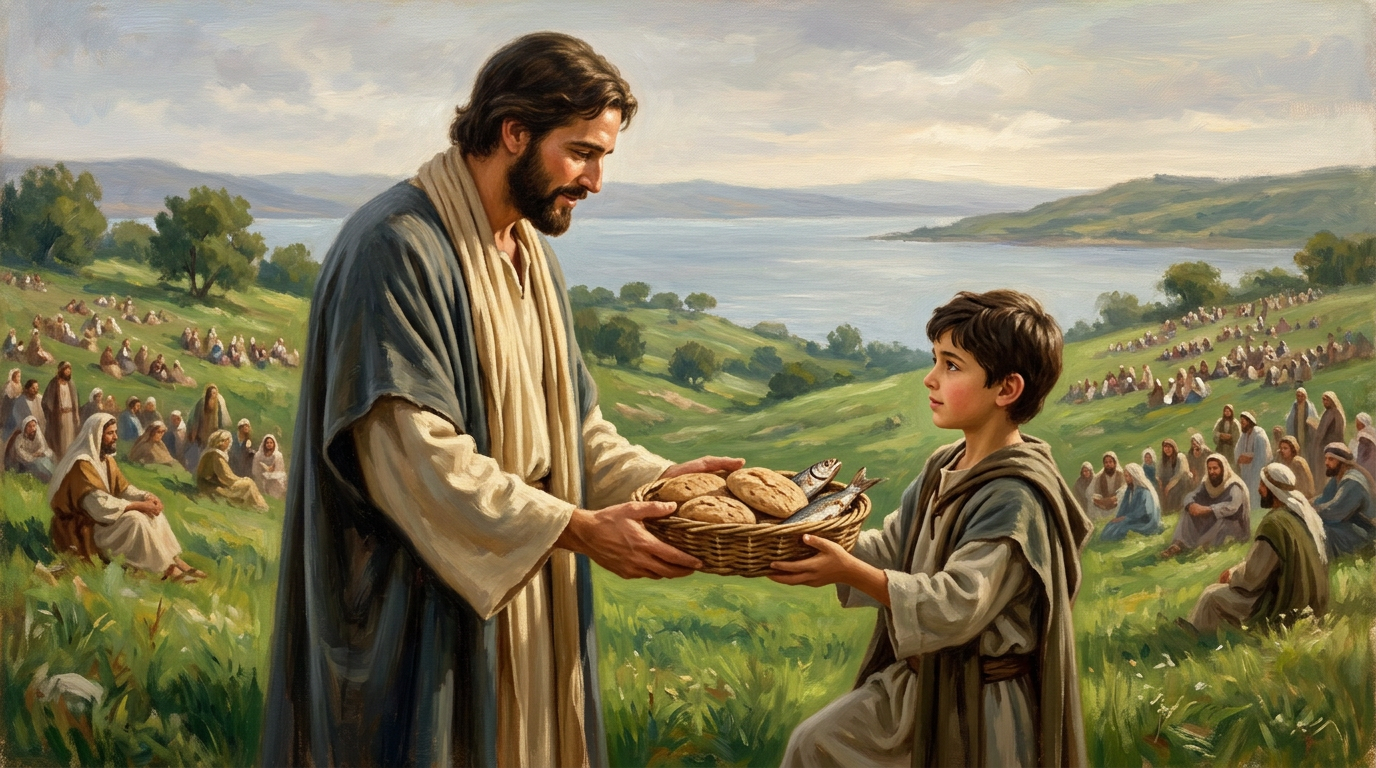
Young boy offering three loaves and two fish
(iii) Samson and the Jawbone of a Donkey (Judges 15)
When trapped by an invading army of Philistines with no conventional weapons in sight, Samson did not wait for a sword to fall from heaven. He looked around, spotted a fresh jawbone of a donkey, grabbed it, and used that crude, discarded object to defeat a thousand men.

Samson holding a donkey's jawbone after defeating an army.
Take inventory of what you already have. It might be a small amount of money, a basic skill, a minor connection, or a seemingly insignificant idea.
Do not despise your small beginning. In your hands, it may look like nothing at all. But when you obey God's word, step out in faith, and offer what you have, you open the door for the God of multiplication to turn your tiny flask into an overflowing harvest.
Don’t just take my word for it! Dive into the full chapter and let these truths stretch your perspective. Press play on our song of the week, and step out in obedience today. See you soon!
